Scorpion sting of Coyotito
The scorpion sting of Coyotito is the inciting crisis of John Steinbeck's The Pearl, a sudden, near-fatal accident that shatters the family's morning peace, exposes the brutal indifference of the town's power structure when the doctor refuses treatment, and directly motivates the desperate pearl dive that yields the great pearl, setting the entire tragic plot in motion.
The Attack and Immediate Response
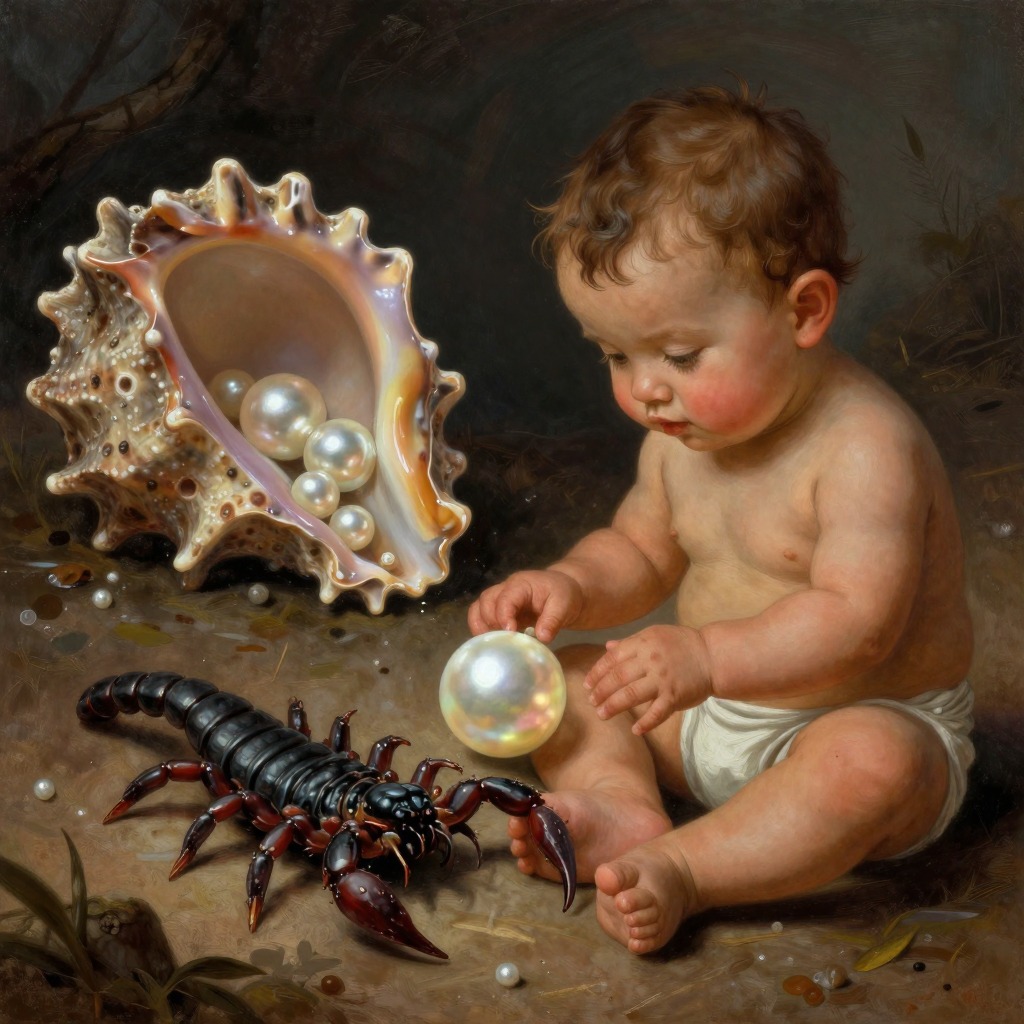
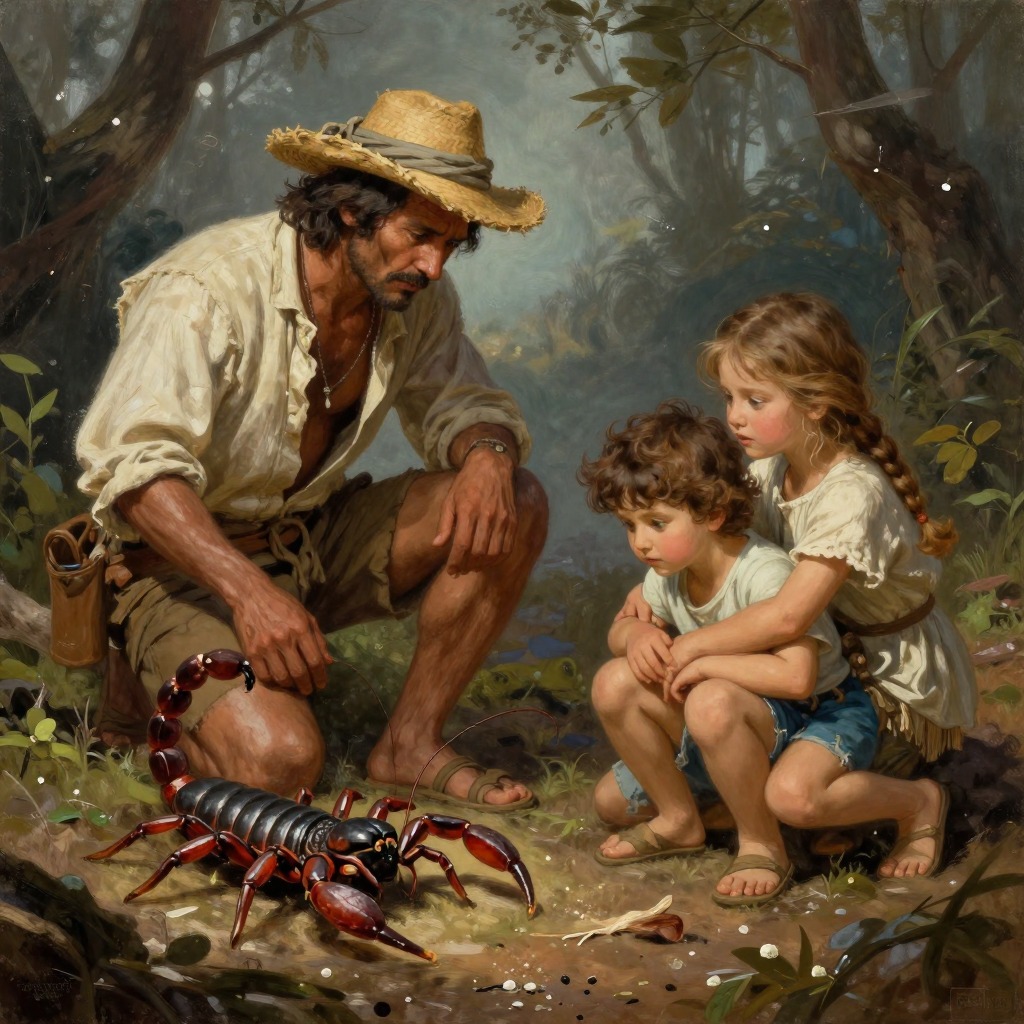
It was a tiny movement that drew Kino and Juana's eyes to the hanging box where Coyotito lay. Down the rope that suspended the baby's box from the roof support, a scorpion moved slowly, its stinging tail straight out behind it but capable of whipping up in a flash. Kino's breath whistled in his nostrils and he opened his mouth to stop it. In his mind a new song had come, the Song of Evil, the music of the enemy, a savage, secret, dangerous melody, and underneath, the Song of the Family cried plaintively. The scorpion moved delicately down the rope toward the box. Under her breath Juana repeated an ancient magic to guard against such evil, and on top of that she muttered a Hail Mary between clenched teeth. Kino glided quietly across the room, his hands in front of him, palms down, his eyes on the scorpion. Beneath it in the hanging box, Coyotito laughed and reached up his hand toward it. The scorpion sensed danger when Kino was almost within reach; it stopped, and its tail rose up over its back in little jerks, the curved thorn on the tail's end glistening. Kino stood perfectly still, hearing Juana whispering the old magic again and the evil music of the enemy. He could not move until the scorpion moved, and it felt for the source of the death that was coming to it. Kino's hand went forward very slowly, very smoothly. The thorned tail jerked upright. At that moment, the laughing Coyotito shook the rope and the scorpion fell. Kino's hand leaped to catch it, but it fell past his fingers, fell on the baby's shoulder, landed and struck. Then, snarling, Kino had it in his fingers, rubbing it to a paste in his hands. He threw it down and beat it into the earth floor with his fist, and Coyotito screamed with pain in his box. Kino beat and stamped the enemy until it was only a fragment and a moist place in the dirt, his teeth bared and fury flaring in his eyes, the Song of the Enemy roaring in his ears. Juana had the baby in her arms now. She found the puncture with redness starting from it already, put her lips down over it, and sucked hard and spat and sucked again while Coyotito screamed. Kino hovered, helpless, in the way.
The Community Gathers and the Doctor Refuses
The screams of the baby brought the neighbors. Out of their brush houses they poured—Kino's brother Juan Tomás and his fat wife Apolonia and their four children crowded in the door and blocked the entrance, while behind them others tried to look in, and one small boy crawled among legs to have a look. Those in front passed the word back: "Scorpion. The baby has been stung." Juana stopped sucking the puncture for a moment. The little hole was slightly enlarged and its edges whitened from the sucking, but the red swelling extended farther around it in a hard lymphatic mound. All of these people knew about the scorpion. An adult might be very ill from the sting, but a baby could easily die from the poison. First, they knew, would come swelling and fever and tightened throat, and then cramps in the stomach, and then Coyotito might die if enough of the poison had gone in. The stinging pain of the bite was going away; Coyotito's screams turned to moans. Kino had often wondered at the iron in his patient, fragile wife. She, who was obedient and respectful and cheerful and patient, could arch her back in child pain with hardly a cry. She could stand fatigue and hunger almost better than Kino himself. In the canoe she was like a strong man. Now she did a most surprising thing. "The doctor," she said. "Go to get the doctor." The word was passed out among the neighbors. A wonderful thing, a memorable thing, to want the doctor. To get him would be a remarkable thing. The doctor never came to the cluster of brush houses. Why should he, when he had more than he could do to take care of the rich people who lived in the stone and plaster houses of the town? "He would not come," the people said. The thought got into Kino. "The doctor would not come," Kino said to Juana. She looked up at him, her eyes as cold as the eyes of a lioness. This was Juana's first baby—this was nearly everything there was in Juana's world. Kino saw her determination, and the music of the family sounded in his head with a steely tone. "Then we will go to him," Juana said. With one hand she arranged her dark blue shawl over her head and made of one end of it a sling to hold the moaning baby and of the other end a shade over his eyes to protect him from the light. The people in the door pushed against those behind to let her through. Kino followed her. They went out of the gate to the rutted path, and the neighbors followed them. The thing had become a neighborhood affair. They made a quick soft-footed procession into the center of the town, first Juana and Kino, and behind them Juan Tomás and Apolonia, her big stomach jiggling with the strenuous pace, then all the neighbors with the children trotting on the flanks. The yellow sun threw their black shadows ahead of them so that they walked on their own shadows. They came to the place where the brush houses stopped and the city of stone and plaster began, the city of harsh outer walls and inner cool gardens where a little water played and the bougainvillaea crusted the walls with purple and brick-red and white. They heard from the secret gardens the singing of caged birds and the splash of cooling water on hot flagstones. The procession crossed the blinding plaza and passed in front of the church. It had grown now, and on the outskirts the hurrying newcomers were being softly informed how the baby had been stung by a scorpion, how the father and mother were taking it to the doctor. The beggars from the front of the church, great experts in financial analysis, looked quickly at Juana's old blue skirt, saw the tears in her shawl, appraised the green ribbon on her braids, read the age of Kino's blanket and the thousand washings of his clothes, and set them down as poverty people and went along to see what kind of drama might develop. They knew the doctor—his ignorance, his cruelty, his avarice, his appetites, his sins—and they followed the procession to see what the fat lazy doctor would do about an indigent baby with a scorpion bite. The scurrying procession came at last to the big gate in the wall of the doctor's house. They could hear the splashing water and the singing of caged birds and the sweep of the long brooms on the flagstones, and they could smell the frying of good bacon from the doctor's house. Kino hesitated. This doctor was not of his people. This doctor was of a race which for nearly four hundred years had beaten and starved and robbed and despised Kino's race, and frightened it too, so that the indigene came humbly to the door. As always when he came near to one of this race, Kino felt weak and afraid and angry at the same time. Rage and terror went together. He could kill the doctor more easily than he could talk to him, for all of the doctor's race spoke to all of Kino's race as though they were simple animals. As Kino raised his right hand to the iron ring knocker in the gate, rage swelled in him, and the pounding music of the enemy beat in his ears, and his lips drew tight against his teeth—but with his left hand he reached to take off his hat. The iron ring pounded against the gate. Kino took off his hat and stood waiting. Coyotito moaned a little in Juana's arms, and she spoke softly to him. The procession crowded close the better to see and hear. After a moment the big gate opened a few inches. Kino could see the green coolness of the garden and the little splashing fountain through the opening. The man who looked out at him was one of his own race. Kino spoke to him in the old language. "The little one—the first born—has been poisoned by the scorpion," Kino said. "He requires the skill of the healer." The gate closed a little, and the servant refused to speak in the old language. "A little moment," he said. "I go to inform myself," and he closed the gate and slid the bolt home. The glaring sun threw the bunched shadows of the people blackly on the white wall. In his chamber, the doctor sat up in his high bed, wearing his dressing gown of red watered silk that had come from Paris. On his lap was a silver tray with a silver chocolate pot and a tiny cup of eggshell china. His eyes rested in puffy little hammocks of flesh and his mouth drooped with discontent. He was growing very stout, and his voice was hoarse with the fat that pressed on his throat. The servant from the gate came to the open door and stood waiting to be noticed. "Yes?" the doctor asked. "It is a little Indian with a baby. He says a scorpion stung it." The doctor put his cup down gently before he let his anger rise. "Have I nothing better to do than cure insect bites for 'little Indians'? I am a doctor, not a veterinary." "Has he any money?" the doctor demanded. "No, they never have any money. I, I alone in the world am supposed to work for nothing—and I am tired of it. See if he has any money!" At the gate, the servant opened the door a trifle and looked out at the waiting people. This time he spoke in the old language. "Have you money to pay for the treatment?" Kino reached into a secret place somewhere under his blanket. He brought out a paper folded many times. Crease by crease he unfolded it, until at last there came to view eight small misshapen seed pearls, as ugly and gray as little ulcers, flattened and almost valueless. The servant took the paper and closed the gate again, but this time he was not gone long. He opened the gate just wide enough to pass the paper back. "The doctor has gone out," he said. "He was called to a serious case." And he shut the gate quickly out of shame. A wave of shame went over the whole procession. They melted away. The beggars went back to the church steps, the stragglers moved off, and the neighbors departed so that the public shaming of Kino would not be in their eyes. For a long time Kino stood in front of the gate with Juana beside him. Slowly he put his suppliant hat on his head. Then, without warning, he struck the gate a crushing blow with his fist. He looked down in wonder at his split knuckles and at the blood that flowed down between his fingers.
Aftermath and the Pearl Dive
Kino and Juana came slowly down to the beach and to Kino's canoe. Juana laid Coyotito on the blanket and placed her shawl over him so that the hot sun could not shine on him. He was quiet now, but the swelling on his shoulder had continued up his neck and under his ear, and his face was puffed and feverish. Juana went to the water and waded in. She gathered some brown seaweed and made a flat damp poultice of it, and this she applied to the baby's swollen shoulder, which was as good a remedy as any and probably better than the doctor could have done. But the remedy lacked his authority because it was simple and didn't cost anything. The stomach cramps had not come to Coyotito. Perhaps Juana had sucked out the poison in time, but she had not sucked out her worry over her first-born. She had not prayed directly for the recovery of the baby—she had prayed that they might find a pearl with which to hire the doctor to cure the baby. Now Kino and Juana slid the canoe down the beach to the water. Kino dived for oysters, and in the song of the undersea there was a secret little inner song, the Song of the Pearl That Might Be. Because the need was great and the desire was great, the little secret melody of the pearl that might be was stronger this morning. Kino saw a very large oyster lying by itself under a little overhang. The shell was partly open, and in the lip-like muscle Kino saw a ghostly gleam, and then the shell closed down. His heart beat out a heavy rhythm and the melody of the maybe pearl shrilled in his ears. Slowly he forced the oyster loose and held it tightly against his breast. He rose to the surface and laid the oyster in the bottom of the canoe. Juana steadied the boat while he climbed in. His eyes were shining with excitement. Very deliberately Kino opened his short strong knife. He squatted in the bottom of the canoe, picked up the shell and examined it. The flutes were shining black to brown, and only a few small barnacles adhered to the shell. Now Kino was reluctant to open it. What he had seen might be a reflection, a piece of flat shell accidentally drifted in, or a complete illusion. But Juana's eyes were on him and she could not wait. "Open it," she said softly. Kino deftly slipped his knife into the edge of the shell. Through the knife he could feel the muscle tighten hard. He worked the blade lever-wise and the closing muscle parted and the shell fell apart. The lip-like flesh writhed up and then subsided. Kino lifted the flesh, and there it lay, the great pearl, perfect as the moon. It captured the light and refined it and gave it back in silver incandescence. It was as large as a sea-gull's egg. It was the greatest pearl in the world. Juana caught her breath and moaned a little. And to Kino the secret melody of the maybe pearl broke clear and beautiful, rich and warm and lovely, glowing and gloating and triumphant. In the surface of the great pearl he could see dream forms. He picked the pearl from the dying flesh and held it in his palm, and he turned it over and saw that its curve was perfect. Juana came near to stare at it in his hand, and it was the hand he had smashed against the doctor's gate, and the torn flesh of the knuckles was turned grayish white by the sea water. Instinctively Juana went to Coyotito where he lay on his father's blanket. She lifted the poultice of seaweed and looked at the shoulder. "Kino," she cried shrilly. He looked past his pearl, and he saw that the swelling was going out of the baby's shoulder, the poison was receding from its body. Then Kino's fist closed over the pearl and his emotion broke over him. He put back his head and howled. His eyes rolled up and he screamed and his body was rigid. The men in the other canoes looked up, startled, and then they dug their paddles into the sea and raced toward Kino's canoe.
Thematic Significance
The scorpion sting is the first intrusion of the external world's evil into the family's idyllic unity, and it establishes the pattern of vulnerability and desperate hope that governs the entire narrative. The doctor's refusal to treat the baby without payment exposes the racial and economic chasm that defines Kino's world, and the shame of that rejection fuels Kino's rage and his determination to find a pearl. The sting also introduces Juana's fierce maternal resolve and her willingness to combine prayer and ancient magic, a resource she will draw on throughout the story. The event's consequences are immediate and far-reaching: it sends Kino to the oyster bed, where he finds the pearl that becomes the object of his obsession and the instrument of the family's destruction. The scorpion itself becomes a recurring symbol of the evil that the pearl attracts, and the memory of the sting haunts Kino's visions in the pearl, where he later sees Coyotito's face "thick and feverish from the medicine." The sting is the first link in a chain of violence that ends with Coyotito's death, and it is the event that Juana later names when she cries that the pearl is "like a sin" and will destroy them all.